Saturday, September 16, 2017

Step-by-step instructions for building the demo app from class:

Hello Purr for App Inventor 2

Building your first app: HelloPurr

Now that you've set up your computer and device, and you've learned how the Designer and the Blocks Editor work, you are ready to build the HelloPurr app. At this point, you should have the Designer or Blocks Editor open in your browser, and either an Android device or an Android emulator connected to the Blocks Editor. (See Setup Instructions for App Inventor 2 if you do not have these things running.)

HelloPurr: tap the kitty, hear him meow

HelloPurr is a simple app that you can build in a very short time. You create a button that has a picture of a cat on it, and then program the button so that when it is clicked a "meow" sound plays.
To build HelloPurr, you'll need a image file of a cat and an audio file with a "meow" sound. Download these files to your computer by clicking the following links. To download: after clicking a link, right click on the image or sound bar and select "Save As." Save both files onto your desktop or downloads folder, or anywhere that you can easily find later.
  • Kitty picture: kitty.png (Right-click and Save)
  • Meow sound: meow.mp3 (Right-click and Save)

Select components to design your app

The App Inventor Components are located on the left hand side of the Designer Window under the title Palette. Components are the basic elements you use to make apps on the Android phone. They're like the ingredients in a recipe. Some components are very simple, like a Label component, which just shows text on the screen, or a Button component (#1 left) that you tap to initiate an action.
Other components are more elaborate: a drawing Canvas that can hold still images or animations, an Accelerometer sensor that works like a Wii controller and detects when you move or shake the phone, components that send text messages, components that play music and video, components that get information from Web sites, and so on.
To use a component in your app, you need to click and drag it onto the viewer in the middle of the Designer. When you add a component to the Viewer (#1 below), it will also appear in the components list on the right hand side of the Viewer.
Components (#2 below) have properties that can be adjusted to change the way the component appears or behaves within the app. To view and change the properties of a component (#3 below), you must first select the desired component in your list of components.
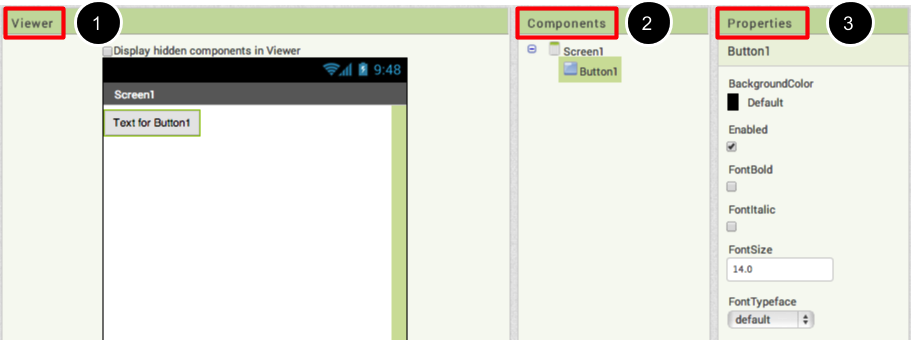
Steps for selecting components and setting properties

HelloPurr will have a Button component that displays the image of the kitty you downloaded earlier. To accomplish this:
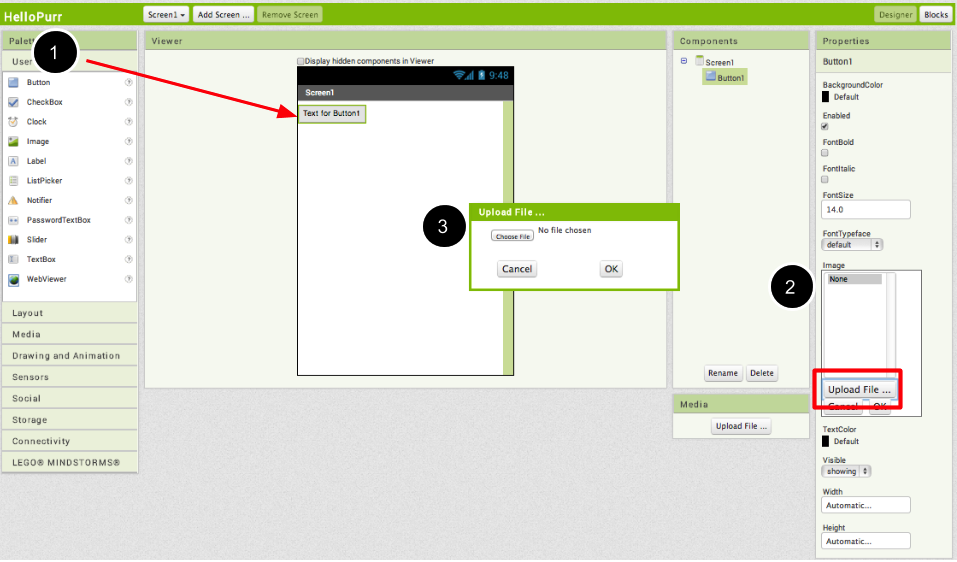
Step 1a. From the User Interface palette, drag and drop the Button component to Screen1 (#1).
Step 1b.To make the button have an image of a cat, in the Properties pane, under Image, click on the text "None..." and click "Upload New…" (#2). A window will pop up to let you choose the image file. Click "Browse" and then navigate to the location of the kitty.png file you downloaded earlier (#3). Click the kitty.png file, click "Open", and then click "OK".
Step 2. Change the Button's Text property: Delete "Text for Button1", leaving the Button's text property blank so that there is no writing over the kitty's face. Your Designer should look like this:
If the entire kitty picture is not showing up, you can fix this by setting the Height and Width properties of the button to "Fill Parent". To do this, click on the Button component, go to the right-hand Properties pane, scroll down to the very bottom to where it says Width and click on the word "Automatic..." to activate the drop down list. Choose "Fill Parent". Do the same for the Height property.

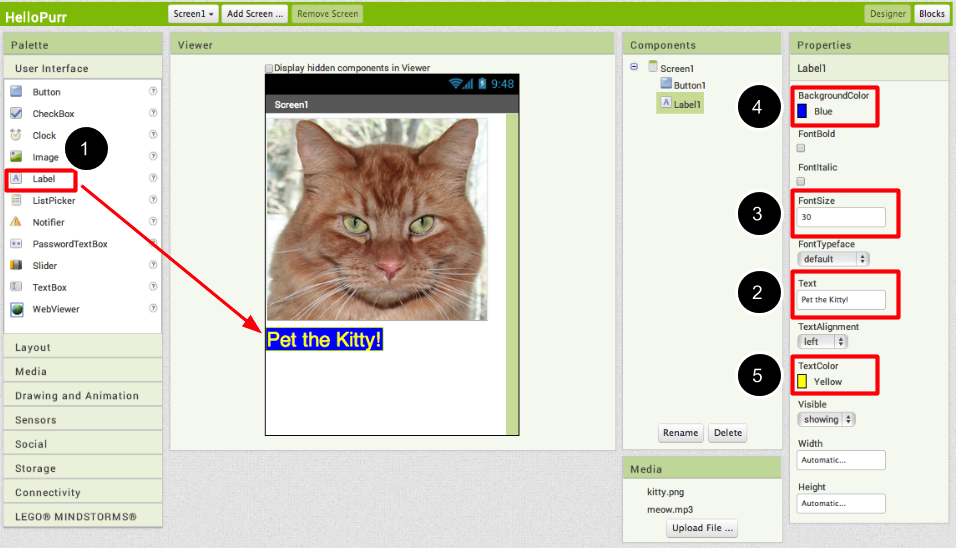
Step 3. From the User Interface palette, drag and drop the Label component to the Viewer (#1), placing it below the picture of the kitty. It will appear under your list of components as Label1.
Under the Properties pane, change the Text property of Label1 to read "Pet the Kitty" (#2). You'll see the text change in the Designer and on your device. Change the FontSize of Label1 to 30 (#3). Change the BackgroundColor of Label1 by clicking on the box (#4): you can change it to any color you like. Change the TextColor of Label1 (#5) to any color you like. Here, the background color is set to blue and the text color is set yellow.
Step 4. Under Palette, click on the Media drawer and drag out a Sound component and place it in the Viewer (#1). Wherever you drop it, it will appear in the area at the bottom of the Viewer marked Non-visible components. Under the Media pane, Click Upload New... (#2) Browse to the location of the meow.mp3 file that you downloaded earlier and upload it to this project (#3). Under the Properties pane, see that the Source property currently says None.... Click the word None... to change the Sound1 component's Source to meow.mp3 (#4).

Programming with the Blocks Editor

So far you have been arranging your app's screen and components in the Designer, which is in a web browser window. To start programming the behavior of the app, you need to go to the Blocks Editor. Click the Blocks button to go to the Blocks Editor.
Once you have the Blocks Editor in front of you, continue to the next step to start programming your app with blocks.

Making the sound play

Step 1. On the left side of the Blocks Editor, click the Button1 drawer to open it. Drag and drop the Button1.Click block in the work area (the open area on the right).
Those mustard yellow blocks are called event handler blocks. The event handler blocks specifiy how the phone should respond to certain events: a button has been pressed, the phone is being shaken, the user is dragging her finger over a canvas, etc. The event handler blocks are mustard yellow in color and use the word when. For example, when Button1.Click is an event handler
.
Step 2. Click the Sound1 drawer and drag the Sound1.Play block and connect it to the "do" section of the when Button1.Click block. The blocks connect together like puzzle pieces and you can hear a clicking sound when they connect.
The purple blocks are called command blocks, which are placed in the body of event handlers. When an event handler is executed, it runs the sequence of commands in its body. A command is a block that specifies an action to be performed (e.g., playing sound) when the event (e.g., pressing Button1) is triggered.
Your blocks should look like this at this point:
Now you can see that the command block is in the event handler. This set of blocks means; "when Button1 is clicked, Sound1 will play." The event handler is like a category of action (e.g., a button is being clicked), and the command specifies the type of action and the details of the action (e.g., playing sound a specified sound).
You can read more about the blocks and how they work here: Understanding Blocks in App Inventor 2.
Try It! When you click the button you should hear the kitty meow. Congratulations, your first app is running!

Installing App Inventor Emulator (only do this if you don't have an Android):


Installing App Inventor 2 Setup on Mac OS X


To get the Android emulator for your Mac, download and install the Setup Package. Click the blue link below to begin the download.
  1. Download the installer.
  2. Double-click the downloaded file to start the installer. (You may need to look in your browser's downloads folder. The file is named AppInventor_Setup_v_X.X.dmg (where the X.X is the version number)
  3. Click continue.
  4. Read and accept the software license agreement.
  5. On the Standard Install screen, click Install. Don't change the install location
  6. If asked, enter your password to confirm that you really want to install software. Click OK.
  7. The installer confirms that the App Inventor Setup package was installed.
If you can't install it because it says it's an unidentified developer, hold down the control button, click on your track pad, and then select "open with installer." 

Tuesday, September 12, 2017

Historical and Cultural Context

Historical and Cultural Context

1. LANGUAGE
The birth of spoken language marked a major development in the evolution of our species. By necessity, oral-based societies became very dependent upon their members to have exceptional memories. The challenge was to accurately pass down from generation to generation as much information as could be remembered. That limitation, however, caused our collective knowledge and information base to grow slowly. As hunter-gatherer societies evolved into more complex agricultural societies, our need for better record keeping intensified.


2. WRITING
Two problems needed to be solved before writing emerged: (1) what symbols to use to represent sounds and ideas, and (2) upon what type of surface could these symbols be recorded.

Sign Writing vs. Phonetic Writing
The first problem was solved in two ways: (1) with systems that used graphic symbols to represent objects, sounds and ideas, e.g., Chinese pictographs and Egyptian hieroglyphics, and (2) with systems that used symbols (later known as alphabet letters) to primarily represent sounds; groups of letters made a word and groups of word made a sentence, a complete thought. The Phoenicians are generally credited for creating the first alphabet. The Romans later modified our alphabet to its present 26 characters.

Clay vs. Paper
Writing surfaces evolved. In Sumeria, soft clay tablets were inscribed with wedge-shaped tool. Egyptians wrote on woven papyrus plants made semi-smooth by rock polishing. Greeks used parchment made from sheep or goat hides; parchment sheets could be stitched together to form scrolls. The Chinese made paper from a pressed pulp made of tree bark and fibrous materials; in use by 100 AD, but unavailable in Europe for another 1,000 years.

Social Impact of Writing:

. created a new division among people; those who could write and read, and those who
  could not, the result was an access or non-access to power garnered through knowledge
. facilitated the birth, growth, and maintenance of powerful ancient empire civilizations
. knowledge could be accumulated by preserving and passing it down to new generations
. laws could be codified and applied consistently throughout the land

The Middle Ages

Began with the fall of Rome in the 6th century. Demand for books continues to rise, but the slow, error-prone, expensive, method of hand-copying each manuscript kept supplies minimal.
Monks in monasteries often took a year to copy just one commissioned book. Mistakes were common and cumulative, and there was no standard book filing or cross-indexing system in use.

By 1150, trade routes were expanding, the idea of universities was emerging, strong central governments began forming, and the need to accumulate information continued to grow. Over the years the demand for more books continued to increase, and eventually book production moved from the religious to the secular arena. Helped by the widespread introduction of paper from China, writing shops, or scriptoria, opened all across the European continent. Nonetheless, supplies were still limited by the number of books that scribes could hand-produce.


3. PRINTING
Though early Asian variations of printing existed before Johann Gutenberg, his use of moveable metal type in 1453 revolutionized communication. Printing could become cheap, quick, and error-free.

Effects of the Gutenberg Revolution

. helped standardize and popularize vernacular (everyday) languages (as opposed to Latin),
which in turn helped spawn the growth of nationalism in Europe in the later Middle Ages
. information quickly became more accessible to a wider range of people
. more books fueled the demand for literacy which in turn created a demand for more books
. generated new schools of social and religious doctrines during the Reformation era, such as Martin Luther’s Protestantism
. accelerated the publication of and interest in scientific research
. helped encourage exploration by the timely publishing of maps, geographical information,
and the colorful accounts of early explorers
. had a profound effect on the growth of accumulated knowledge, with more books resulting
in an increased number of scholars and students; helped make possible the Renaissance of the 16th Century
. led to the development of current concept of “news”

Technology and Cultural Change

If we ascribe too much credit for cultural change to a specific technology, we risk viewing social development through the narrow lens of technological determinism, the view that technology drives historical change. A more moderate position might suggest that technology functions with various social, economic, and cultural forces to help bring about those changes.

The introduction of moveable type marked the start of what we generally define as mass communication, a critical event in Western history.


4. THE TELEGRAPH AND TELEPHONE

Development of the Telegraph

Before the telegraph, messages traveled only as fast as the fastest form of transportation; but with one invention the speed of communication went from 30 miles per hour (train) to 186,000 miles per second (the speed of light). It was the first device that made possible instantaneous point-to-point communication at huge distances. The word telegraph comes from Greek words meaning “to write at a distance.” It was also the first technology to use digital signals—dots and dashes.
Using a device to vary the time an electric current was sent across the wires, the telegraph made point-to-point communication possible by sending codes across the wires. Samuel Morse’s code of telegraphic dots and dashes, still in use today, is the most famous.

Cultural Impact of the Telegraph

. by 1850, almost every city on our Western frontier was linked with other cities
. in 1866, the U.S. laid a trans-Atlantic cable connecting America with Europe

Parallel to the expansion of the railroads, the telegraph helped change the way we moved goods, coordinated services (particularly military actions), and helped speed up communication between buyers and sellers. Because of near-instant communication, market prices between cities were standardized and stabilized. The telegraph also affected the flow of news, making it both possible and a commercial “must” to carry up-to-the-day’s events from far distant points. News stories also became shorter due to the fact that telegraph services charged by the word.

Government and Media

Unlike other countries where the telegraph was seen as an extension of the postal service, and therefore under logical control and operation of the government, the United States followed a model of private ownership and commercial development.

A Change in Perspective

The telegraph changed how people thought of distance; as the new device reconfigured old concepts of space and time, every “there” became a “here.” We began rethinking our world, as mass media writer Marshall McLuhan came to describe it, as a “Global Village.” Thanks to the telegraph system, most countries on the planet became inextricably linked together.

Soon after the telegraph, the telephone began linking people together by voice, eliminating the need to understand telegraphic codes. Its ability to network and offer private communications made it a “must have” in homes and businesses. And just as big business came to dominate the telegraph industry (Western Union), AT&T (which later acquired Western Union) quickly became the giant of the telephone industry.


5. PHOTOGRAPHY AND MOTION PICTURES

Early Technological Development

Two inventions were needed to make photography a reality:

. a way to focus light rays from a subject onto a surface
. a way to permanently store (and copy) those images

In the 16th century artists discovered that they could project an inverted image of a subject in the end of a dark box through a pinhole at the other end of the box, a device called the camera obscura (dark chamber).

In the 1830s, two Frenchmen, Joseph Niepce and Louis Daguerre, found a way to capture images on glass plates treated with silver iodide. Early photos (called Daguerreotypes) required long exposure times, and made them particularly suitable for portrait work. At about the same time William Fox Talbot, from England, found a way to store images (and subsequently produce multiple copies) on paper. In the 1890s, George Eastman introduced and marketed his new box camera, the Brownie, thus making photography accessible to the masses.

Mathew Brady

Brady was the first to capture war—in this case our Civil War—on film, giving a more accurate, rather than glorified, record of what war was actually like. Though most of his glass plate negatives were lost, enough survived to show generations then and now the real horrors of warfare; his pictures, and their impact on the public, were a forerunner to what television would show us 100 years later in the Vietnam war.

Photography also affected art, dispensing with any need art may have had to accurately depict the real word. Photography freed artists to interpret the world and events in new and unique ways. Photography itself became its own art form, however, and spawned such noted photographers as Alfred Steiglitz, Margaret Bourke-White, Edward Steichen, and Ansel Adams.

Photography’s Influence on Mass Culture


Once in the hands of the masses, photography enabled people to create a permanent record of their personal histories. Printing advances made it easy to publish photographs in magazines and newspapers, creating a new profession—photojournalism. The 1920s saw a surge in time-saving devices, and the spread of photographic news added to that movement; Americans could now see, rather than have to read, newsworthy events. Printed columns soon decreased while space devoted to pictures increased; the movement later gave birth to such popular picture magazines such as Life and Look. Partly as a result, our definition of news became visually biased; news became that which could be shown.

Pictures in Motion

Helped by the advent of three great social movements (industrialization, urbanization, and immigration), the demand for film entertainment flourished in crude store-front theaters around the 1900s. By 1910 there were over 10,000 of these nickelodeons, which helped create the motion picture industry.

Motion Pictures and American Culture

Eventually, only the large companies who could afford to produce feature length films survived. They soon dominated the production, distribution, and exhibition of movies. The film industry killed Vaudeville and forever altered our concept of leisure time activities. In part due to photography and the  mass appeal newspaper, a mass culture of idolized film stars, movie images, and popularized portrayals of model “American” values and cultural icons was created.

Film gave impetus to a perceived need to study what impact motion pictures (and later other media) might have on the public psyche; the 1930s Payne Fund was one of the first serious efforts to investigate the media’s potential effects. During the 1930s film also injected itself into journalism in the form of newsreels, ten-minute short takes of various news, sports, weather, and human interest stories. Dying out in the 1950s under pressure from TV news, the newsreel format continues to influence the conventions of present day TV news formats.

6. RADIO AND TELEVISION BROADCASTING

A byproduct of electromagnetic research in physics, the advent of radio (or wireless as it was first known) in the 1910s made it possible for one source to send a message to multiple receivers. In World War I military planners quickly saw radio’s applicability to warfare, thus encouraging both research and development in the medium while at the same time ending some long-standing patent wars that had delayed radio’s development.

Broadcasting

Radio’s one-to-many communication format, known as broadcasting, was the first medium to bring sports, music, talk, and news into the American living room. Manufacturing radio sets, the original profit motive for radio, was soon replaced in the 1920s by advertising (selling air time, or rather supplying audiences to businesses for a fee).

Radio growth was so frenzied, however, that the government was forced to intervene in 1927 by establishing the Federal Radio Commission to regulate radio’s technical side. In 1934. the FRC was replaced by the Federal Communications Commission; after that, the government opted to take a hands off approach to radio content, leaving radio’s fortunes in the hands of business.

Paralleling an era of newspaper consolidation, two national radio networks (later three) emerged. Radio content quickly moved toward mass appeal programs, which provided huge audiences for major advertisers. During the 1930s, economic pressures from the Great Depression forced many out-of-work Vaudeville performers to enter radio, thus increasing the level of professionalism and appeal of network programming. In the late 1930s, radio journalism came into being as a new and strong news medium and strongly rivaled the newspaper industry.

Cultural Impact of Radio

. radio helped popularize different kinds of music
. radio introduced a new entertainment genre, the soap opera, which by 1940 accounted for
some 60 percent of all daytime network programming
. radio was first medium to introduce mass content aimed at children, thus recognizing
children as a viable commercial market
. radio was first to introduce situation comedies, a program genre that’s become a staple on
television
. radio news came of age in the 1930s-40s as a result of serious world events.
. radio personalized news, giving rise to trusted and well-known news celebrities
. radio changed how Americans spent their free time – by the 1930s-40s, radio had become
the prime source of American entertainment and news in usually during the early evening hours, later known as prime time.

Television

Halted during WW II, television’s growth surged during the prosperous era of the early 1950s. Pent up consumer demand fueled spending (and thus TV ad dollars) following the war years. Sales of TV sets took off (it took only 10 years to be in 85 percent of U.S. homes), and an increasing amount of American leisure time was now being spent in front of the TV set.

Cultural Impact of TV

Television is in 99 percent of all households, and the set is on for over seven hours a day. It’s become our third largest time consumer (third only to sleep and work), and in the process it’s transforming almost every aspect of our culture, from politics, to religion, to news, and to the way we learn.

Today we routinely expect live coverage of events from anywhere at anytime. Time and space no longer seem important, and we have all come to share a national, even global, consciousness through the common visual icons provided by television—the Japanese Tsunami, the Arab Spring, President Kennedy's funeral, the Apollo moon landings, the Challenger explosion, and the planes striking the World Trade Center on September 11, 2001, etc.


7. THE DIGITAL REVOLUTION

Nicholas Negroponte, MIT’s Media Laboratory Director, summed up the digital revolution as the difference between atoms and bits. Information, once solely comprised of atoms (material goods such as paper, film, tapes, and CDs) and which moved to and from the marketplace relatively slowly, is rapidly being replaced by the instantaneous transfer of bits—electronic zeros and ones.

Digital technology is a system that encodes information—sound, text, data, graphics and video—into a series of on-and-off pulses, denoted as zeros and ones. Once digitized, information can be easily copied and transported at extremely low costs. Digital technology and the Internet have triggered a revolution in the way information is stored and transmitted.

Digital technology is now mainstream (Netflix, Amazon, YouTube, Twitter, Facebook, DVR, Digital TV, HDTV, Hulu, etc.).


Social and cultural implications of the digital age are considerable.
. many of the creative arts have embraced digital technology.
. the notion of what “community” means may have to be rethought, with relationships that
can be formed on the basis of needs and interests rather than locale
. consider what the digital age might mean for politics; perhaps representative democracy
could be rivaled by a digital democracy made possible by direct and instantaneous links
between the people and their government.
. there’s the problem of the digital divide, or the problem of the “have” and “have-nots”—
those who can afford the technology and have the training to use it, and those who can’t
and don’t.

8. WIRELESS HANDHELD MEDIA

Smart phones, laptop computers, and tablet computers share common characteristics:

. they are linked together using wireless technology
. they are portable and allow users to access information from anywhere
. they are interconnected and allow users to hook into the worldwide phone network or the
Internet
. they combine features of mass communication and interpersonal communication

These devices will eventually merge into one, and have the potential to transform traditional media drastically and to alter American culture. Some of the changes we've already seen include:

. they have changed the practice of journalism, replacing pencil and paper as the tools of the
trade, and allowing reporters to send text, audio, and pictures from the field
. many media organizations are distributing content to wireless media
. wireless mobile media have taken on some of the surveillance functions of the media
. they facilitate mobile parenting
. they have "softened" the concept of time
. on the downside, they allow people to coordinate illegal activities, they can impair driving,
they can create social annoyance, and they cost money – will the digital divide increase?


CONCLUDING OBSERVATIONS

. it’s difficult to accurately predict the ultimate use of any new medium.


. it appears that the emergence of any new communication advance changes but does not make extinct those advances that came before it.

Functions of Mass Media

Perspectives on Mass Communication

Models to guide how we think about mass communication processes. Examples of paradigms include the functional and the critical/cultural approaches. Paradigms are helpful because they:

. provide a perspective from which to examine mass communication
. generate concepts to understand media behavior
. help us identify important components or elements in the process


FUNCTIONAL ANALYSIS


In is simplest form, the functional approach holds that something is best understood by examining how it is used. In mass communication, this means examining the uses that audiences make of their interactions with the media.

The Role of Mass Communication

. different media provide different primary uses.
. macroanalysis considers what functions the media provide for society as a whole.
. microanalysis considers what functions the media provide for the individual.

Functions of Mass Communication for Society

For society to exist, certain communication needs must be met. These needs existed long before the advent of mass media. As society became larger, these functions became too large to be handled by single individuals. We should consider the consequences of performing these communication functions via the mass media. Some of these consequences are harmful or negative and are called dysfunctions.


Surveillance.
Refers to role media plays in relaying news and information. There are two main types. Warning (beware) surveillance: occurs when the mass media warn us about impending dangers such as storms, economic declines, military threats, etc.; also used to warn of long-term dangers such as diseases, pollution, population growth, etc. Instrumental surveillance: information that is useful and helpful in everyday life such as movie schedules, stock quotes, sports scores, fads, new products, how-to pieces, etc. Note that not all examples of surveillance occur in the news media; instrumental surveillance often comes from a wide variety of other media sources.

There are several consequences of relying on the mass media for surveillance:

. news (accurate accounts as well as mistaken ones) travels further and faster than ever.
. news of events comes to us second-hand and is usually not personally verifiable; as such,
we’ve come to place our trust in media, or grant the media credibility.
. as a dysfunction, media surveillance can create unnecessary anxiety
. being featured by the mass media may give individuals or issues status conferral, a belief
by the audience—justified or not—that simply being featured is a sign of importance.

Interpretation.
Refers to role media plays in giving meaning and significance to events. Gatekeepers provide interpretations, comments, analysis, and opinions on various events so as to give the audience a better understanding of the event’s relative importance to society.

There are several benefits of relying on the mass media for interpretation:

. audiences are exposed to a wider range of often contrasting viewpoints
. allows us to weigh all sides of an issue before deciding on our position
. gives us a greater depth of expertise upon which to draw conclusions

There are several potential consequences of relying on the mass media for interpretation:

. no guarantee that media interpretations are accurate or valid
. individuals could become overly dependent on media interpretation and lose the ability to
analyze situations or think for themselves

Linkage.
Brings together various elements of society that are not directly connected. The linkage can be based on common interests, usually matching wants with needs, e.g., buyer with seller; dating services; lost and found; Internet outlets such as e-Bay, WebMD, chat rooms, newsgroups, and listservs.

Transmission of Values (socialization).
Refers to ways in which an individual comes to adopt the behavior and values of a group. Individuals exposed to media portrayals of certain types of behavior and value systems are likely to grow up and accept them as their own, and thus pass along these values from one generation to another.

There are several consequences of relying on the mass media for socialization:

. helps stabilize society by creating common bonds between members in terms of shared values
and experiences
. bear in mind that the values and cultural information presented in the media is usually selected
by large groups that encourage the status quo.
. the media can also transmit values by enforcing social norms

Television may play a special role in socialization:

. of all mass media, television has the greatest potential for establishing common social values
. by age 18, the average person has spent more time watching TV than doing anything else
except sleep
. dysfunctions can occur if youngsters watching violent content are socialized into accepting
violence as a means of problem solving
. TV serves as a source of knowledge (accurately or not) about occupations and role models
. many TV images of minority groups reflect the stereotypes held by majority population (Whites)


Entertainment.
The importance of this media function has grown proportionately to the rise in our collective leisure time, and we are spending increasing amounts of that leisure time being passively entertained by all forms of the mass media.

There are several consequences of relying on the mass media for entertainment:

. most entertainment content is designed to appeal to the lowest common denominator of taste
. being passively entertained may inhibit our ability to actively entertain ourselves


How People Use the Mass Media


At the individual level, the functional approach is called the uses-and-gratifications model. This model holds that audience members have certain needs or drives that are satisfied by using both non-media and media sources. Media uses are generally broken down into four categories: cognition, social utility, diversion, and withdrawal.

Cognition.
The process of coming to know something, which is closely parallel to the surveillance function. On the individual level, there are two different types of cognitive functions:

. using media to keep up with current events
. using media to satisfy a desire for general knowledge

Diversion.
Using the media to “get away from it all.” Types of diversion include stimulation, relaxation, and emotional release.

. Stimulation involves seeking some sort of emotional or intellectual mental activity.

. Relaxation involves seeking relief from sensory overload. The type of content is not
the defining factor, because different people find different media material relaxing.

. Emotional release involves seeking some type of emotional catharsis, generally by
creating a vicarious participation in, or empathy with, a situation (fictional or otherwise)
depicted in the media.

Social Utility.
Seeking social integration or affiliation with others, generally by using the mass media as a common denominator of experience. Social utility can manifest itself in several forms, including:

. Conversational currency: Provides a common ground of information and experiences, which can be used to strike up a conversation

. Parasocial relationships: develop when individuals develop feelings of kinship or
friendship with media characters (fictional or not).


Withdrawal.
Using media to create a barrier or buffer zone between oneself and other people or activities.

Content and Context.
It’s important to remember that it’s not only the media content that determines media use, but also the social context within which the media exposure occurs. For example, when going to the theater, the content of a film may be perceived as having less value than the opportunity to socialize with one's peers.

The functional approach to studying mass media makes several assumptions:

. Audiences take an active role in their interaction with various media, and people's needs
provide motivation for media use.

. The mass media are not the only sources to satisfy people's needs; for example, relaxation can be achieved by taking a nap.

. The uses-and-gratification approach assumes that people are aware of their own needs and are able to verbalize them. The approach relies on survey methodology.

A list of prominent shows/production companies run by POC

Recognizing that the lack of diversity continues to be a problem in the entertainment media industry, it's important to be aware of thos...