EXCLUSIVE: Filming on the upcoming sixth and final season of Netflix’s Washington D.C.-set drama House of Cards has been suspended indefinitely. Cast and crew of the MRC-produced series were told of the decision this morning.
“MRC and Netflix have decided to suspend production on House of Cards season six, until further notice, to give us time to review the current situation and to address any concerns of our cast and crew,” the two companies said in a joint statement to Deadline.
The news comes less than 24 hours after Netflix announced that House of Cards will end with its upcoming sixth season as allegations of unwanted sexual advances in 1986 byHoC star Kevin Spacey against then-14-year-old Anthony Rapp had emerged.
The Emmy-nominated House of Cards had been in production in Baltimore on its sixth season. Executives from Netflix and MRC arrived in the city Monday “to meet with our cast and crew to ensure that they continue to feel safe and supported” following the allegations against Spacey, who had not been scheduled to be on set yesterday.
“Media Rights Capital and Netflix are deeply troubled by last night’s news concerning Kevin Spacey,” the companies said in a joint statement Monday.
Season 6 of House of Cards had been expected to consist of 13 episodes and debut in mid-2018 on Netflix. It is unclear yet how the stop of production would impact that.
Less than two weeks ago, HoC had to deal with a mass shooting that took place a mile from its Baltimore set. It ended up not affecting production.
In what has been a career-defining and critically praised role, Spacey plays the manipulative and murderous now ex-President Francis Underwood in the Netflix series. Season 5 of the show ended with Robin Wright’s Claire Underwood now in the Oval Office as America’s first female POTUS as Spacey’s Underwood resigned in disgrace.
Having helped launch Netflix’s original programming explosion in 2013, the David Fincher-produced House of Cards was created by Beau Willimon based on the 1990 BBC series from Michael Dobbs’ novel. With the series coming to an end, Netflix and MRC had been exploring potential spinoffs.
Here is an amazing glimpse into the dark side of the force that is Hollywood economics. The actor who played Darth Vader still has not received residuals from the 1983 film "Return of the Jedi" because the movie, which ranks 15th in U.S. box office history, still has no technical profits to distribute.
How can a movie that grossed $475 million on a $32 million budget not turn a profit? It comes down to Tinseltown accounting. As Planet Money explained in an interview with Edward Jay Epstein in 2010, studios typically set up a separate "corporation" for each movie they produce. Like any company, it calculates profits by subtracting expenses from revenues. Erase any possible profit, the studio charges this "movie corporation" a big fee that overshadows the film's revenue. For accounting purposes, the movie is a money "loser" and there are no profits to distribute.
Confused? Imagine you're running a lemonade stand with your buddy Steve. Your mom says you have to share half your profits with your sister. But you don't wanna! So you pretend your buddy Steve is actually a corporation -- call him Steve, Inc -- charging you rent for the stand, the spoon, etc. "Dang, mom, I don't have any profits, I had to pay it all to Steve, Inc!" you say when you come home. But the money isn't gone. It's as good as yours -- in your best friend's pocket.
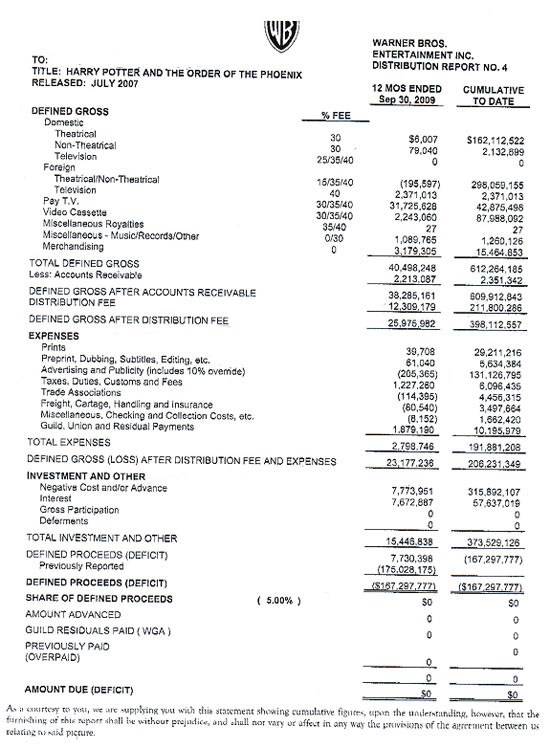
So: "Return of the Jedi" is a $475 million lemonade stand. Hollywood can't really work like this, you're thinking. But it does. Last year, the website Techdirt revealed a balance sheet from "Harry Potter and the Order of the Phoenix", which, under Hollywood accounting, ended up with a $167 million "loss" even though it's one of the top grossing films of the last decade. Warner Bros. charged about $350 million in distribution, advertising, and interest fees to this external corporation. Here's the receipt.
This brings us back to Darth. "Return of the Jedi" made almost half a billion dollars. But Return of the Jedi, Inc, still has no profit to pay its famous villain because the movie corp has paid so much of its revenue back to the studio in distribution fees. Here's actor David Prowse, via Techdirt:
"I get these occasional letters from Lucasfilm saying that we regret to inform you that as Return of the Jedi has never gone into profit, we've got nothing to send you. Now here we're talking about one of the biggest releases of all time," said Prowse. "I don't want to look like I'm bitching about it," he said, "but on the other hand, if there's a pot of gold somewhere that I ought to be having a share of, I would like to see it."
Most corporations try to make a profit by limiting costs. Movies corporations manage to record a loss by maximizing costs. Only in Hollywood, indeed.
Anyone who submits an idea to Park Tank will get +3 points of extra credit.
One example might be an app designed to teach kids about media literacy. It can be a fun game where they learn about techniques used by advertisers and producers to get them to "like" something. You can charge $1.99 for it and try to work it into the curricula of school media literacy programs across the country. (If someone wants to use this idea, let me know).
Submit Your Idea to ParkTank - Deadline Extended
Do you have an idea for an online business, a game-changing app, or industry disrupting device? We want you to share your idea for a chance to win a share of $1000. Complete the submission form by 6:30 pm on Thursday, October 26th at bit.ly/parktank2017 and participate in the live event that will take place on November 3rd at The Studio.
For your 4th reaction, please read the articles on the blog titled "Judgment Day for Harvey Weinstein" and "Harvey Weinstein Fallout" and write a reaction (250 words minimum).
You may want to consider the following:
Do you think this will change the culture in Hollywood? Why or why not?
What are your thoughts, in general, about Harvey Weinstein's behavior (and others like him)?
What can be done to improve the situation?
Are you surprised by the number of individuals now facing accusations? Why or why not?
Please post your reaction on Sakai (under Tests & Quizzes) by Thursday, October 26th by midnight PDT.
The Harvey Weinstein sexual abuse scandal has rocked the world of Hollywood to its core. Allegations by more than 50 women have brought to light decades of sexual harassment, abuse and rape, by Weinstein.
Beyond Weinstein, entertainment and media companies are taking allegations of sexual harassment and assault extremely seriously. Here is a list of the some other media and entertainment figures who have been accused of sexual misbehavior since the Weinstein story first broke on Oct. 5.
Roy Price: The president of Amazon Studios was suspended and ultimately resigned after Isa Hackett, executive producer on Amazon’s “The Man in High Castle,” claimed that Price pressured her for sex, made an obscene joke related to the title of Amazon’s “I Love Dick,” and whispered obscenities to her. Price’s fiancee also cancelled their wedding due to the allegations less than a month before the planned date.
Chris Savino: The creator and showrunner of Nickelodeon’s “The Loud House” was fired after a suspension when a dozen women came forward accusing Savino of inappropriate conduct over several years, including unwanted sexual advances as well as threats of retribution after the end of consensual relationships.
Lockhart Steele: Steele, Vox Media’s editorial director and former CEO and founder of Curbed Network, was fired after he admitted to allegations that he engaged in improper conduct with a former employee. In a post on Medium, Eden Rohatensky claimed that she had been harassed by several employees including an unnamed “company VP…[caressed] my hand. And then my arm. And then suddenly, in the dark corner of the car, he was kissing my neck.”
Andy Signore: Signore, Defy Media’s SVP of content who created the popular Youtube channel “Screen Junkies” and the Emmy-nominated parody series “Honest Trailers,” was fired after a brief suspension. Several women accused Signore of sexual harassment and assault, and one woman said he threatened to fire her boyfriend, who worked for Screen Junkies, if she publicly spoke about the allegations.
Matt Mondanile: Guitarist Matt Mondanile was fired form the indie band Real Estate last February, and although the reason given at the time was that he left to pursue other musical projects, the band released a statement on October 13 saying that he was really fired after “allegations of unacceptable treatment of women were brought to our attention.” Though he initially denied the allegations, Mondanile later issued a statement via his lawyers apologizing for “inappropriate behavior” and calling himself an “insensitive creep,” while at the same time saying that “much of what has been written and talked about is false and defamatory.”
Harvey Weinstein’s implosion has been cathartic for Lauren Sivan, one of the dozens of women who have come forward in recent days alleging that the once-celebrated mogul was a serial sexual harasser and abuser. It’s a moment of justice and public condemnation that seemed all but impossible to imagine mere weeks ago when Weinstein enjoyed a position as one of the most powerful figures in media, a skilled operator whose connections stretched from Capitol Hill to Wall Street and whose sense of entitlement knew no bounds.
“You reap what you sow,” says Sivan. “I know that he believed for years that he was untouchable, and a lot of people helped him be untouchable.”
CREDIT: PETER STRAIN FOR VARIETY
Weinstein’s precipitous fall has been stunning, if not a long time coming. He’s been fired from his own company, ostracized by his longtime friends and collaborators in the entertainment industry, transformed from power player to butt of late-night talk-show jokes, ditched by his wife and abandoned by the Democratic political leaders who once coveted his endorsement. The Weinstein Co. is weighing a sale to Colony Capital.
Along with Bill Cosby, Roger Ailes, Bill O’Reilly and L.A. Reid, Weinstein is a sign that the old methods that stars and top executives used to cover up their sins isn’t working. Their praetorian guards of lawyers and spin-makers, their penchant for paying hush money to victims and making them sign draconian nondisclosure agreements that prevent them from going public, can no longer buy silence.
Hollywood’s veil of secrecy has been pierced, and such complicity and enabling may no longer be tolerated in a company town that has long protected its own.
“We are shining a bright light on aggressors and powerful offenders as an example to every other employee out there,” says TV commentator Wendy Walsh, one of O’Reilly’s accusers.
As the chorus of accusers grows daily and as Weinstein finds himself isolated and abandoned by the A-list stars and directors he once claimed as friends, the conversation in Hollywood is pointing to a major shift. The hope in the industry is that the alleged abhorrent behavior by Weinstein and the other perpetrators will trigger some genuine soul-searching across the entertainment business and beyond.
Instead of simply inspiring big names in the industry to release anodyne statements that are light on substance and heavy on synonyms for deplorable, there’s an urge to have a deeper conversation about how to improve the climate and culture in Hollywood so whistle-blowers are supported and predators aren’t rewarded with corner offices, private jets and a license to operate with impunity.
“Pretty much all anyone can talk about is ‘How can we prevent this situation from happening again?’” says Mary Parent, vice chairman of worldwide production at Legendary Entertainment. “We all know the past can’t be changed. All we can do is change the future.”
But is an industry that gave convicted rapist Roman Polanski an Oscar, lionized and named buildings for sexual predators like MGM founder Louis B. Mayer and looked the other way as Weinstein’s behavior with women became an open secret, ready to change? Will the latest abuse scandal — the worst in modern-day movie business history — force studios to embrace a zero-tolerance environment where it will no longer be possible for powerful, privileged men to prey on actresses and underlings and not be held accountable for their bad behavior? Studio executives and filmmakers believe the litany of accusers who are coming out of the shadows could represent an inflection point in Hollywood.
“Bottom line, no matter what rung of the corporate ladder you’re on, bad behavior will not be tolerated,” says Bonnie Hammer, chairman of NBCUniversal Cable Entertainment. “Period.”
Going forward, Hammer might be right. However, the movie business has a lot to answer for. All told, some 30 women, including major actresses such as Angelina Jolie, Gwyneth Paltrow, Ashley Judd, Kate Beckinsale and Mira Sorvino, have shared stories of intimidation and abuse at the hands of Weinstein dating back to the 1980s. His list of alleged misdeeds ranges from making unwanted advances to movie stars and subordinates to forced vaginal and oral sex. Weinstein’s behavior was flagrant enough that Seth MacFarlane joked while reading out a list of Oscar nominees in 2013 that the supporting actress contenders would no longer have to pretend to be attracted to the indie chief.
In Weinstein’s case, watchdog institutions failed. One former associate of his noted that in the past he used his connections to kill or gut negative stories, calling up publishers or leaning on editors who were part of his social circle, and coercing them with either the promise of exclusives to come or the threat of litigation. That didn’t work in the case of The New York Times and The New Yorker, both of which broke key elements of the abuse and assault stories, and it doesn’t appear to be working with social media platforms. His accusers haven’t just gone on television or talked to newspapers and magazines. In many cases, they’ve abandoned traditional media outlets altogether, breaking their silence on Twitter or Instagram. Weinstein’s Old Testament-style reckoning has been delivered with digital-era speed and fury, which is likely to cause more problems for harassers who have yet to be exposed.
Reverberations are being felt across the Hollywood landscape, as the industry prepares for a kind of expurgation. More names are joining the ranks of O’Reilly, Cosby and Ailes. In the wake of the Weinstein scandal, Amazon Studios chief Roy Price was put on a leave of absence after Isa Hackett, a producer on the Amazon series “The Man in the High Castle,” reported that she had to repeatedly deflect his propositions. The claim happened two years ago, but after Hackett went public, the blowback online became so fierce that within hours Price was sidelined.
Even before Weinstein’s season in purgatory, there have been other examples of the power of tweets and Facebook shares. Ain’t It Cool News creator Harry Knowles was brought low by accusations of lewd contact with women, while Devin Faraci, another influential film blogger, lost his post at Birth.Movies.Death after being accused of sexually assaulting a woman nearly a decade ago. In both cases, social media sites helped spread the word and fueled demand for action.
There is a sense of momentum now — a feeling that women have become emboldened to speak out. Gretchen Carlson, the former Fox News host whose lawsuit against Ailes helped spark a wave of claims that led to his stunning ouster, believes there’s a growing strength in numbers.
“Women have not had the courage to come forward because nothing good comes from it — except for now,” says Carlson. “Once I jumped off the cliff, I truly believe others could see that it could happen and you could be OK. I’m proud to know that one woman can make a difference, and look at how empowered others are now. I see so much progress now.”
Maya Raghu, director of workplace equality for the Washington, D.C.-based National Women’s Law Center, suggests that the real test of change is what happens at companies like Fox News or the Weinstein Co. long after the controversy. “Once you’re done reacting to these revelations, then what?” she says. “You may have gotten rid of the serial harasser, but what steps are you taking to stop it from happening again? Firing a person is not the end; it’s just the beginning.”
Shaunna Thomas, co-founder of Ultra-Violet, an advocacy group focused on combating sexual harassment and assault, says the bombshell stories exposing three decades of misconduct by Weinstein present a powerful opportunity to begin improving workplace culture.
“Hopefully this story is big enough and the truth is shocking enough that it sets a new standard for what is acceptable,” Thomas says. “What we hope comes out of it is culture change.”
Changing attitudes is likely more important than codifying safeguards against sexual harassment, Thomassuggests. “You can change rules, laws, policies, but if the culture of Hollywood or the culture of any industry is essentially designed to protect people like Harvey Weinstein, then those [new] laws and rules don’t matter,” she says.
Harvey Weinstein and Gwyneth Paltrow were among those sharing Oscars for “Shakespeare in Love.” Paltrow says Weinstein harassed her two years earlier when she was making “Emma” for Miramax. THEODORE WOOD/CAMERA PRESS/REDUX
Of course, abuse and mistreatment of women extends beyond Hollywood. A 2015 survey of 2,235 female workers conducted by Cosmopolitan magazine found that one in three women had experienced sexual harassment in the workplace. The survey also found that less than a third of women reported the harassment and only 15% felt the report was handled fairly. For too many women, unwanted advances and salacious comments are just a fact of life.
“There isn’t a woman I know who hasn’t had to deal with some type of discrimination in some way,” says industry vet Gail Berman, co-owner and founder of the Jackal Group. “You hope you’re not complacent, but you do learn to live with it and navigate through it rather than fight against it, because that’s generally been a better way to proceed.”
There are other structural issues at play that have enabled a casting couch culture to endure well past the advent of modern feminism. For one thing, it’s a hard business to break into, and many of the young women Weinstein harassed were offered parts in movies or jobs in exchange for sexual favors. It’s no accident that some of his alleged assaults took place at what were billed as hotel-room auditions.
“What makes Harvey and other powerful people like him so onerous is that they are the gatekeepers,” says Paul Feig, the director of “Bridesmaids.” “They are the ones who hold the keys to people’s hopes and dreams. So people think they have to put up with it and stay silent because with one phone call they can blacklist people.”
Feig has an idea for evening the odds. He notes that human resources departments aren’t enough — and in some cases women abused by Weinstein weren’t his employees. He wants to create a hotline where victims of harassment can anonymously report on people who have abused them.
“We don’t want to start a witch hunt, but if there’s a pattern of behavior going on, we want people to know about it,” he says. “We can’t have a system where people think there’s no chance they’ll get caught.”
Nina Jacobson, producer of the “Hunger Games” franchise, believes that the law needs to be changed around nondisclosure agreements. It’s fine, she reasons, for companies to protect proprietary information.
Covering up immoral or illegal behavior is another thing.
“We want to get to a place where the cost of silence is greater than the cost of speaking out,” she says. “We want to shift the shame to the bully and away from the victims.”
Cathy Schulman, the Oscar-winning producer of “Crash” and the president of the advocacy group Women in Film, compared the feeling to what she experienced the morning after Election Day, as it gradually sank in that America had elected Donald Trump, a man who bragged on tape about grabbing women by the genitals. “When you’re a star … you can do anything,”
he boasts. Weinstein, notes Schulman, was partly responsible for dozens of Oscar nominations and several best picture wins. He had a reputation for making highbrow, acclaimed films such as “The English Patient” and “The King’s Speech.” Few had ascended to such heights.
We want to get to a place where the cost of silence is greater than the cost of speaking out. We want to shift the shame to the bully and away from the victims.” NINA JACOBSON
“We all wonder how it’s possible that we allowed Harvey Weinstein to climb to the top of the pyramid of aspiration,” she says. “That this very same person who we put in this position had this dark past is saddening for all of us.”
Schulman believes there are reasons women stay silent. It’s not just about harassment or abuse; she hears constantly about the ways that female executives struggle with institutional sexism in other aspects of their professional lives.
“If you say, ‘It seems as if we’re only going out to male directors’ or ‘Why don’t we increase the woman’s point of view in a script?’ or ‘Doesn’t this part feel over-sexualized?,’ you’re immediately labeled a problem,” she says. “The response is something along the lines of ‘There you go with the women’s issues again.’”
In recent years, there’s been a widespread debate about the lack of diversity in Hollywood. Male executives vastly outnumber their female counterparts, female directors represent a rounding error, actresses get paid less than actors and women producers are far less common than men. In the case of the Weinstein Co., every one of its board members and its top three executives was male. It all adds up to a culture that’s ripe for abuse.
“The more women there are in powerful positions, that makes this less likely to happen,” says Berman. “As we all know, it’s a power issue.”
Kirby Dick, the director of “The Hunting Ground” and “The Invisible War,” documentaries that examined rape culture on college campuses and in the military, agrees that having more women in media company boardrooms and studio executive suites is one of the surest ways to prevent more predators.
“Studies show that when women in an institution hold 30% or more of the positions of authority, the institution begins to make significant changes,” said Dick. “Hollywood is nowhere near that figure.”
The recent high-profile cases of abuse suggest that the problem could be rooted in a generational change in the workplace. The spate of misconduct allegations have been largely leveled at men in their 60s and 70s, and Weinstein, 65, himself initially argued that he came of age in another era, when gender dynamics were viewed differently.
Nancy Dubuc, president-CEO of A+E Networks, isn’t convinced it’s an issue of age but rather of a personality type that gravitates to abuse of power in an industry known for tolerating enfants terribles. She calls the tendency of some people to “abuse their power,” whether through physical or verbal harassment, an “epidemic” in the industry.
There’s a vicious cycle of emotional violence. People come into the industry, working grueling hours in agency mail rooms or as production assistants on film sets, where they are screamed at and belittled. As they rise, they hurl the same invective at underlings that they once were forced to endure.
JBob and Harvey Weinstein formed Miramax Films in 1979. The brothers have been feuding for the past few years. J EMILIO FLORES/THE NEW YORK TIM
“It’s going to take a long time for this mind-set to erode,” says Dubuc. “It’s going to take a lot of listening and soul-searching to understand why this environment was created and who’s willing to step forward and change it if we’re really going to solve it for the next generation.”
There’s also a lot of money at stake — and prestige. While Weinstein was making hit movies like “Pulp Fiction” and “The Artist,” and winning Oscars in the process, it was easy to ignore his bullying. Tyne Daly, the star of “Judging Amy” and “Cagney & Lacey,” echoes Dubuc in believing that too much bad behavior has been indulged.
“Unless we have an example of our better angels or better behavior, then it’s kind of a free-for-all,” she says. “I’m hoping that people will be kinder, more honest and less — if we can say this in Variety — full of s**t.”
The major reason that women and men haven’t come forward with their own stories of harassment is economic. There’s a concern that if they speak out, they will lose everything. That’s something commentator Walsh had to grapple with before she went public. She was a contributor to Fox News’ “The O’Reilly Factor” until she turned down the host’s offer to visit his hotel suite. She found herself blacklisted from the program and scared to speak out.
“I was terrified,” recalls Walsh. “I was afraid this powerful man with his aggressive lawyers would take my house. I’m a single mother so this thought was debilitating. I was afraid I would be attacked by the media. I was afraid I would lose my job or my sponsors.”
Walsh and others eventually came forward to The New York Times. After breaking their silence, O’Reilly was pushed from his primetime perch. The experience left her with firm ideas about what needs to change.
“Remove the code of silence,” she says. “Give more power to human resource departments. Take women and men who have been harassed seriously.”
It certainly seems as though victims are coming forward in greater numbers and finding more receptive audiences. It wasn’t always so. When Weinstein ran into Sivan on red carpets in Hollywood over the past decade, the indie mogul acted as if she were a stranger. The brush-off was odd given that 10 years before, when Sivan was a cub reporter in New York City, Weinstein had cornered her in the basement of a restaurant and masturbated in front of her. Despite the painful memories, when Sivan covered film premieres she’d steel herself and ask Weinstein questions. If she ignored him, she wouldn’t be doing her job, she reasoned.
“If he recognized me, he never let on,” Sivan recounts. “I assumed that I was one of many.”
Last week, Weinstein’s days of ignoring women like Sivan ended.
“I’m just overwhelmingly satisfied that one random encounter I had with him 10 years ago in a basement of a bar could help lead to his downfall,” she says. “That’s wildly satisfying to me.”
Some people might even call it karma.
Ricardo Lopez, Cynthia Littleton and Mannie Holmes contributed to this report.



 Here is an amazing glimpse into the dark side of the force that is Hollywood economics. The actor who played Darth Vader still has not received residuals from the 1983 film "Return of the Jedi" because the movie, which ranks 15th in U.S. box office history, still has no technical profits to distribute.